💬
Everyday EnglishDescribe · Tell · Say · Flow
Open hub →
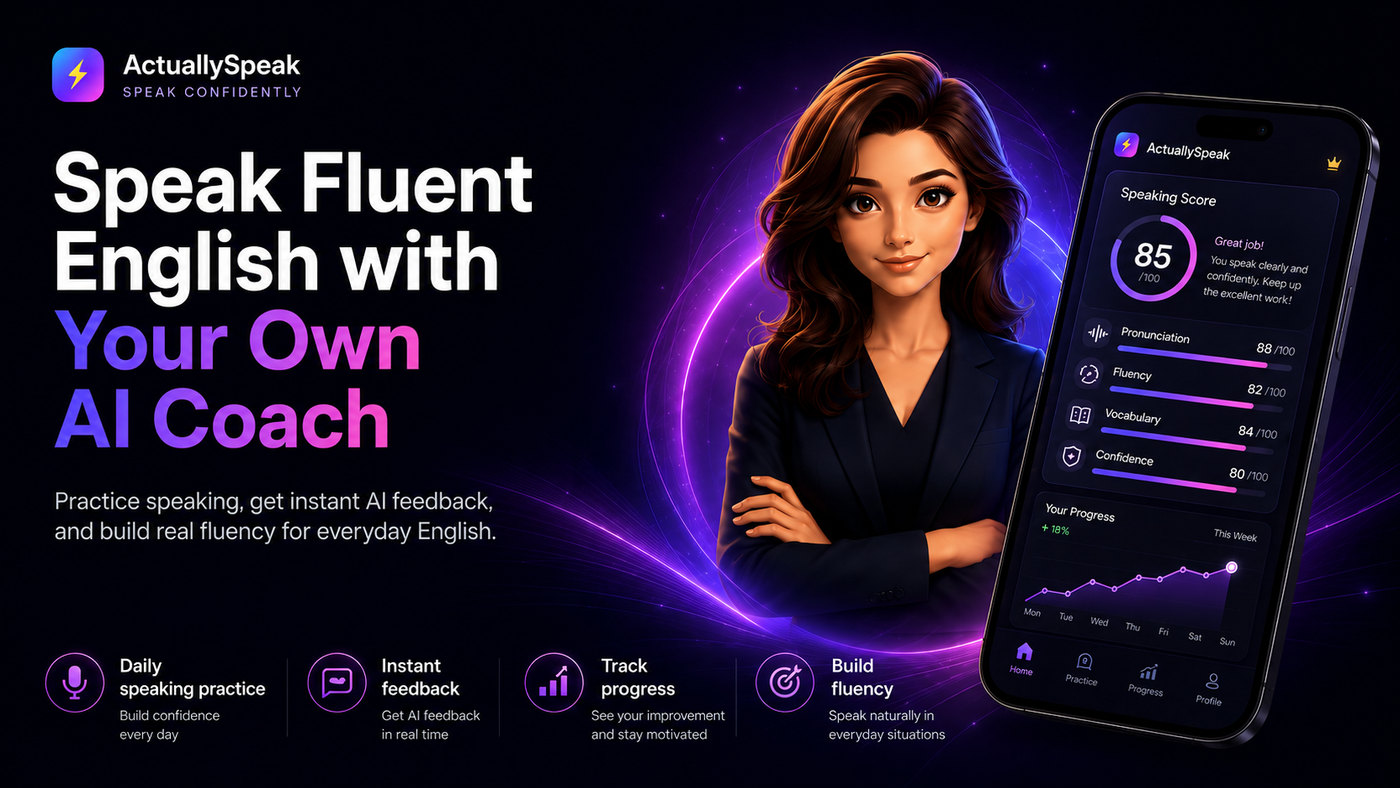
ActuallySpeak Everyday English — an AI coach scoring your speaking 85/100 with pronunciation, fluency, vocabulary and confidence feedback, plus a weekly progress chart.
For people who understand English but freeze when they speak it

You don't need more English. You need somewhere to use it out loud.

You've done the apps. You watch the shows. You understand almost everything. And then someone asks you a simple question and it all disappears — you translate in your head, you lose the sentence halfway, and you hear yourself sounding like less than you are. That isn't a knowledge problem. It's a reps problem. Everyday English is the part of ActuallySpeak that gives you the reps: real scenes to describe, out loud, with feedback, every day.

Not sure yet? Find your speaking level free — about 5 minutes → Or go straight to the hub 🌱 Just starting out? There's a beginner path for A1 & A2 →
Does this sound like you?
You freeze and forget words the moment you speak

In your head the sentence was there. Out loud it vanished. You know the word — you've known it for years — and it will come back to you twenty minutes after the conversation ended, which is the most frustrating part.

→ Fixed by: daily scene practice that makes speaking the default action, not the rare one. Recall under pressure is a separate skill from knowing, and it only trains one way.
You lose your train of thought mid-sentence

You start well, then somewhere in the middle you're building the grammar and choosing the word and remembering the point all at once, and one of them drops. So you stop, restart, or just trail off and let someone else take the turn.

→ Fixed by: the Flow skill in the Skill Gym — layering description, story and opinion into one answer, so the sentence has a shape before you start it.
You can't keep a conversation going

You can answer a question. You can't yet turn the answer into a conversation — so there's a pause, and the pause feels like your fault, and you start avoiding the situations where pauses happen.

→ Fixed by: Rapport & Real Talk, the 12-week course on the psychology of rapport, your own story bank, and the informal English people actually speak.
People don't always understand your pronunciation

You have to repeat yourself. Sometimes twice. Nobody is unkind about it, but you notice it, and you start choosing shorter, safer, smaller sentences to reduce the chance of it happening again.

→ Fixed by: the pronunciation diagnostic, which finds the specific sounds costing you clarity, then drills those instead of everything.
You struggle to explain what you actually think

You have opinions. Detailed ones. In English they come out as "I think it's good" — and you can hear the gap between the thought and the sentence, which is worse than not having the thought at all.

→ Fixed by: the Say skill — opinions and ideas, said and defended out loud, with feedback on whether the reasoning actually landed.
You read and listen constantly, but rarely speak

Your input is huge and your output is nearly zero. You're not lazy — there's just nowhere safe to speak. No partner, no class, no one to correct you, and practising alone in an empty room feels ridiculous.

→ Fixed by: 1,200+ scenes you can talk to at 6am or midnight, scored by AI, with nobody watching and nothing to be embarrassed about.
Why it isn't workingThe honest diagnosis, not the pep talk
Input is not practice. You have been studying, not speaking.

Reading, listening and watching build a bigger passive English — the English you can understand. Speaking builds active English, the English you can produce at speed. They're different systems, and almost nobody's input hours translate into output ability by themselves. If you have spent years on input and still freeze, that is not evidence you're bad at English. It's evidence you have been training the wrong half.

Practice without feedback just rehearses your mistakes.

Talking to yourself in the shower is better than nothing, but it has no correction loop — whatever you do wrong, you do wrong more fluently every time. Feedback is what turns repetition into improvement, and it has to arrive close to the moment you spoke, while you still remember what you were trying to say.

You froze because you were building the sentence and delivering it at the same time.

Fluent speakers aren't faster translators. They've stopped translating — they reach for whole chunks and known shapes instead of assembling every sentence from scratch. That's why describing things out loud, repeatedly, works so well: it builds the chunks, so that under pressure there's something ready to reach for instead of an empty grammar table.

Confidence is a result, not a prerequisite.

Waiting to feel ready before you speak is the loop that keeps most people stuck for years, because confidence is downstream of evidence and you can't get evidence without speaking. The way out is boring and reliable: speak in a place where being wrong costs nothing, often enough that being heard stops feeling like a test.

What you actually get
🗣️
Conversation Practice — 80 spoken roleplays
The closest thing here to the real moment. You pick a situation, and the other person talks to you out loud, in character — you answer out loud, they answer back. 80 scenarios from A1 to B2 across eight kinds of everyday moment: food & drink, travel, making friends, office & work, everyday admin, borders & visas, networking & events, and business English. If you freeze mid-turn, the key phrases are on screen.
What you get from it: the reps you can't get anywhere else — a two-way conversation you can restart as many times as you like, with nobody sighing at you.
Start a conversation →
🧭
Travel & Real Life — rehearse it first
The airport, the hotel desk, the doctor's, asking directions, the bank, the first day at work. Every situation here is one people freeze in. Open one, tap any phrase to hear it, say it back, then take it into a real scene at your level.
What you get from it: the exact sentences for the moment, rehearsed before you're standing in it — so the trip stops being the part you dread.
Rehearse a situation →
🗺️
Street Talk — 370 real slang terms
Textbook English gets you understood. Street talk gets you included. 370 words locals actually use, from 24 regions across the UK and the US, on a tappable map — with accent notes, spoken examples, what to say back, and what not to say.
What you get from it: you stop being the person who missed the joke — and you know which words travel and which ones belong to one city.
Pick a place →
📚
The courses, all in one place
Rapport & Real Talk over 12 weeks, Describe Anything Like a Native, the Skill Gym, and the graded CEFR library week by week. One page that tells you which of them you should open first, based on where you actually are.
What you get from it: a route instead of a menu — so you're not choosing between four good things every time you sit down.
Browse the courses →
🎬
1,200+ real scenes to describe
Real-life scenes across 50+ topics — everyday life, travel, food, technology, people, films, music, sport, weather, shopping, health, money, work, neighbours, weddings, wildlife and dozens more. You watch, you talk, the AI scores what you said and tells you what to fix.
What you get from it: unlimited AI-scored speaking practice, with daily prompts matched to your CEFR level — so it's never too easy to bother with or too hard to attempt.
Explore the topics →
🎯
The Skill Gym — four trainable skills
Speaking isn't one ability, so it isn't trained as one. The gym splits it into four, tracks each separately from needs work to strong, and always points you at your weakest one.
🖼️
Describe
The concrete world — objects, places, people, scenes.
📖
Tell
Events and experiences — tell what happened.
💡
Say
Opinions and ideas — say what you think, and why.
🌊
Flow
Layer all three smoothly into one natural answer.
What you get from it: a live score on each of the four skills and a workout aimed at whichever one is holding the other three back.
Start a workout →
👀
Describe Anything Like a Native
A 3-module mini course for the exact moment you go blank in front of a photo, a person or a situation. One repeatable system — See, Organise, 3D, Muscles, Clothes, Story — drilled out loud until describing anything is a reflex rather than a search.
What you get from it: a test and retest on every lesson, plus a printable workbook — so you can see the reflex forming instead of hoping it is.
Start Module 1 →
🤝
Rapport & Real Talk — 12 weeks
The bridge from test English to real relationships: the psychology of rapport, your own story bank built week by week, and the informal English natives actually use when nobody is marking them.
What you get from it: a personal story bank you can reach for in any conversation, instead of restarting from nothing every time someone asks about you.
Start Week 1 →
🎧
Catch It — turn your TV into a lesson
Didn't catch what they said in a show? Rewind, hold your phone towards the screen and tap. Your coach hears the line, explains it, and saves the words straight to your flashcards.
What you get from it: the English you actually wanted to understand tonight — captured at the moment you cared about it, which is the moment it sticks.
Catch tonight's first line →
Just starting out?Everything above assumes you already speak some English. If you don't yet, start here.
🌱
The beginner path — built for A1 and A2
If English is still new to you — first words, short phrases, nothing automatic yet — the scenes and the level test will move too fast, and that isn't your fault. This is the other door. A 30-second setup in your own language, then real words learned in context with pictures and sound: the word, its family, its partners, real sentences, and the sayings people actually use. You say every one of them out loud and get scored on it.
What you get from it: a starting point that fits you — instead of a test pitched above your level and a library you can't use yet.
Start the 3-step setup →
The offerEverything unlocks together — there is no half version
⚡ Today
Full access
Every scene, every roleplay, every course. £0 charged.
🔔 Day 5
We email you
The date and the amount, before anything happens.
⭐ Day 7
You decide
Your membership starts — unless you cancelled. Two taps.

You see the exact price and the exact billing date on the next screen, before you enter any card details. Nothing is charged today, and cancelling inside the 7 days costs you nothing at all.

Your 14-day right to cancel. Paid access starts the moment you pay, and you keep a 14-day statutory right to cancel from that point — see the Refund & Cancellation Policy for exactly how it works. After that, cancel any time and keep your access until the end of the period you've already paid for. Payments are handled by Stripe; we never see your card.
Who this is not for

Not for people who want to learn English without speaking it. Everything here is built around your voice. If you're looking for something to read, watch or tap through silently, you already have those — and they're the reason you're still stuck.

Not a replacement for a human teacher, and we won't pretend otherwise. The AI scores what you said and shows you what to fix, at any hour, for a few pounds a month. It does not know your life, and it can't do what a good coach does. If you want a person, Smooth English coaching is a separate thing — apply here.

Not for anyone expecting fluency on a timetable. There's no "fluent in 30 days" claim on this page because we can't honestly make one. What we can promise is that you will speak more English this month than you did last month, and that you'll get told what to fix each time.

Not for people who want to practise once a week and see a change. The whole design assumes short, daily, out-loud reps. If you can't give it a few minutes most days, the honest answer is that it won't do much for you.

Frequently asked
What level do I need to start?
Anywhere from beginner upwards. There's a short level test at the start and daily prompts are matched to your CEFR level from then on, so the scenes move up as you do. If you're right at the beginning, start with the free beginner picture test instead — it's built for A1 and A2.
How do the 7 free days work?
£0 today. You start the trial with a card on file so your access doesn't break if you decide to stay, but nothing is taken until day 7. On the screen before checkout you'll see the exact price and the exact date of the first payment. Cancel any time inside the 7 days and you are charged nothing at all.
What if I forget to cancel?
That's what the day-5 email is for. We send it automatically, two days before the trial ends, with the date and the amount in it — so the first payment is never a surprise. You don't have to set a reminder yourself.
How do I cancel?
Two taps, from the link in that reminder email or by replying to it. No phone call, no form, no "are you sure" maze.
Does it work in China?
Yes. The whole app is served through actuallyspeak.com and everything it needs is proxied through our own domain, so nothing depends on a blocked service. On payment, be aware of one real limitation: Alipay and WeChat Pay cannot do recurring billing through Stripe, our card processor. So from mainland China it's either an international card for monthly or yearly, or a single yearly payment via Alipay or WeChat — one payment, no auto-renewal, and we remind you before it ends. The 7-day free trial needs a recurring card, so it is not available on the Alipay/WeChat route.
Do I need a speaking partner or a set class time?
No, and that's rather the point. Every scene is something you can talk to alone, at whatever hour suits you, with nobody listening and nothing to be embarrassed about. The feedback comes from the AI, immediately, whether it's 6am or midnight.
How long does a session take?
A few minutes. A single scene or a Skill Gym workout is short on purpose — the thing that produces change is doing it most days, not doing an hour once. Short sessions you actually repeat beat long sessions you avoid.
Is the AI feedback actually useful, or just a score?
You get a score, and you get what to fix. It's aimed at the things that decide whether you're understood — whether the answer had a shape, whether the words carried the idea, and which sounds are costing you clarity. It's not a human examiner, and the page above says so plainly.
Can I cancel?
Any time — no contract and no lock-in. You keep access until the end of the period you've already paid for. You also have a 14-day statutory right to cancel from the moment paid access begins; the Refund & Cancellation Policy sets out how that works when the service has already been supplied.
What's the difference between this and the IELTS app?
Different destination. This one is for real life — being understood, being interesting, being yourself in English. The IELTS app trains for a specific band on a specific exam. If you have a test date, start there instead; if you have a life you want to live in English, you're in the right place.

The next sentence you say out loud is the one that changes it.

Three minutes tells you exactly why you freeze — and which part of Everyday English to open first.

← Back to the Everyday English hub
Terms · Privacy · Refunds & Cancellation