You don't need more English. You need somewhere to use it out loud.
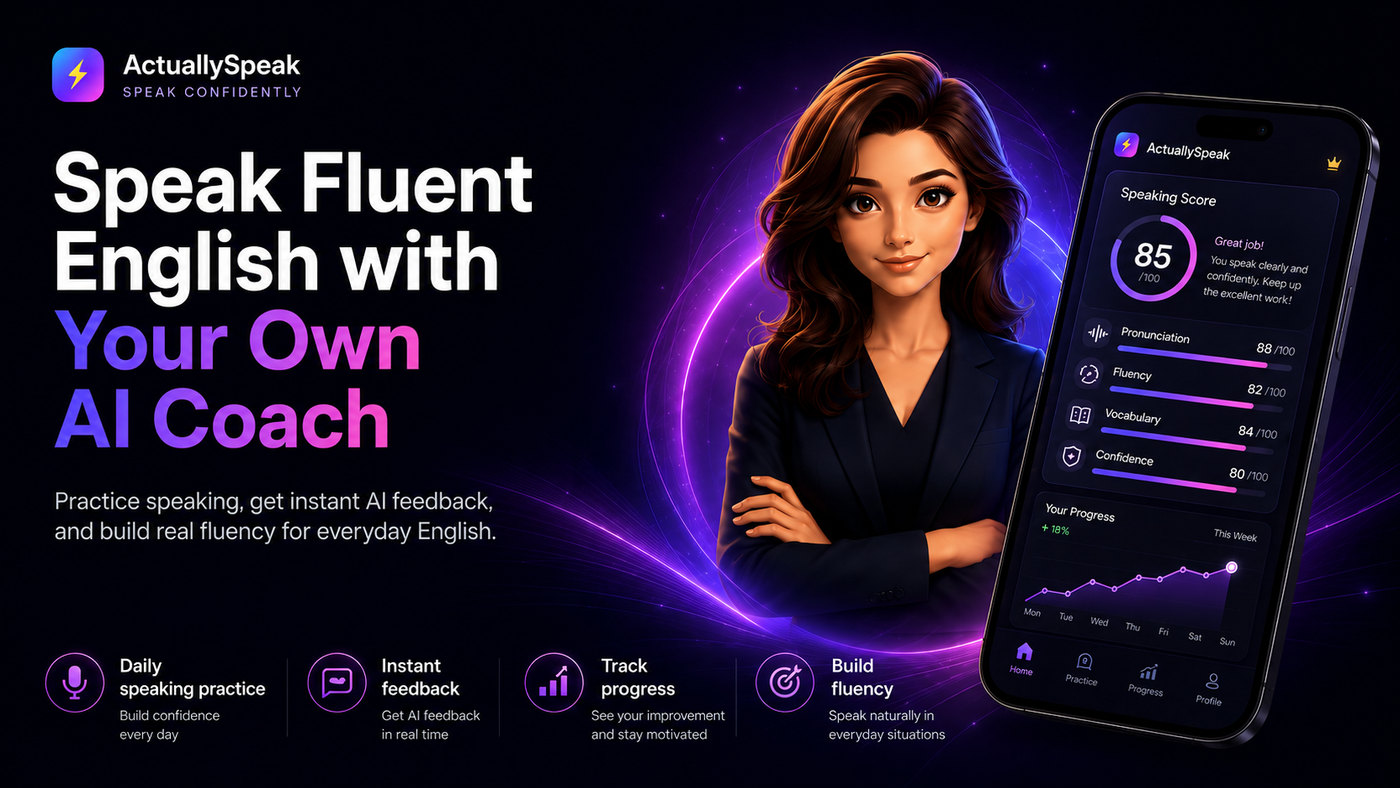
You've done the apps. You watch the shows. You understand almost everything. And then someone asks you a simple question and it all disappears — you translate in your head, you lose the sentence halfway, and you hear yourself sounding like less than you are. That isn't a knowledge problem. It's a reps problem. Everyday English is the part of ActuallySpeak that gives you the reps: real scenes to describe, out loud, with feedback, every day.
Start free — about 3 minutesFind out why you're freezing → Or go straight to the hubIn your head the sentence was there. Out loud it vanished. You know the word — you've known it for years — and it will come back to you twenty minutes after the conversation ended, which is the most frustrating part.
You start well, then somewhere in the middle you're building the grammar and choosing the word and remembering the point all at once, and one of them drops. So you stop, restart, or just trail off and let someone else take the turn.
You can answer a question. You can't yet turn the answer into a conversation — so there's a pause, and the pause feels like your fault, and you start avoiding the situations where pauses happen.
You have to repeat yourself. Sometimes twice. Nobody is unkind about it, but you notice it, and you start choosing shorter, safer, smaller sentences to reduce the chance of it happening again.
You have opinions. Detailed ones. In English they come out as "I think it's good" — and you can hear the gap between the thought and the sentence, which is worse than not having the thought at all.
Your input is huge and your output is nearly zero. You're not lazy — there's just nowhere safe to speak. No partner, no class, no one to correct you, and practising alone in an empty room feels ridiculous.
Reading, listening and watching build a bigger passive English — the English you can understand. Speaking builds active English, the English you can produce at speed. They're different systems, and almost nobody's input hours translate into output ability by themselves. If you have spent years on input and still freeze, that is not evidence you're bad at English. It's evidence you have been training the wrong half.
Talking to yourself in the shower is better than nothing, but it has no correction loop — whatever you do wrong, you do wrong more fluently every time. Feedback is what turns repetition into improvement, and it has to arrive close to the moment you spoke, while you still remember what you were trying to say.
Fluent speakers aren't faster translators. They've stopped translating — they reach for whole chunks and known shapes instead of assembling every sentence from scratch. That's why describing things out loud, repeatedly, works so well: it builds the chunks, so that under pressure there's something ready to reach for instead of an empty grammar table.
Waiting to feel ready before you speak is the loop that keeps most people stuck for years, because confidence is downstream of evidence and you can't get evidence without speaking. The way out is boring and reliable: speak in a place where being wrong costs nothing, often enough that being heard stops feeling like a test.
- Unlimited AI-scored speaking practice
- 1,200+ real-life scenes across 20 topics
- Daily prompts matched to your CEFR level
- Pronunciation diagnostic + targeted drills
- Progress tracking — see your level climb week by week
- Cancel any time — no contract, no lock-in
The app opens with 5 free practices the first time you use it — no card, no checkout, nothing to cancel. Paying is a separate decision you make afterwards, once you already know whether you speak more with it than without it.
Not for people who want to learn English without speaking it. Everything here is built around your voice. If you're looking for something to read, watch or tap through silently, you already have those — and they're the reason you're still stuck.
Not a replacement for a human teacher, and we won't pretend otherwise. The AI scores what you said and shows you what to fix, at any hour, for a few pounds a month. It does not know your life, and it can't do what a good coach does. If you want a person, Smooth English coaching is a separate thing — apply here.
Not for anyone expecting fluency on a timetable. There's no "fluent in 30 days" claim on this page because we can't honestly make one. What we can promise is that you will speak more English this month than you did last month, and that you'll get told what to fix each time.
Not for people who want to practise once a week and see a change. The whole design assumes short, daily, out-loud reps. If you can't give it a few minutes most days, the honest answer is that it won't do much for you.
What level do I need to start?
How do the 5 free practices work?
Does it work in China?
Do I need a speaking partner or a set class time?
How long does a session take?
Is the AI feedback actually useful, or just a score?
Can I cancel?
What's the difference between this and the IELTS app?
The next sentence you say out loud is the one that changes it.
Three minutes tells you exactly why you freeze — and which part of Everyday English to open first.